



HRRG to Champion Press Freedom and Disability Inclusion at RightsCon 2026 in Zambia
 Human Rights Reporters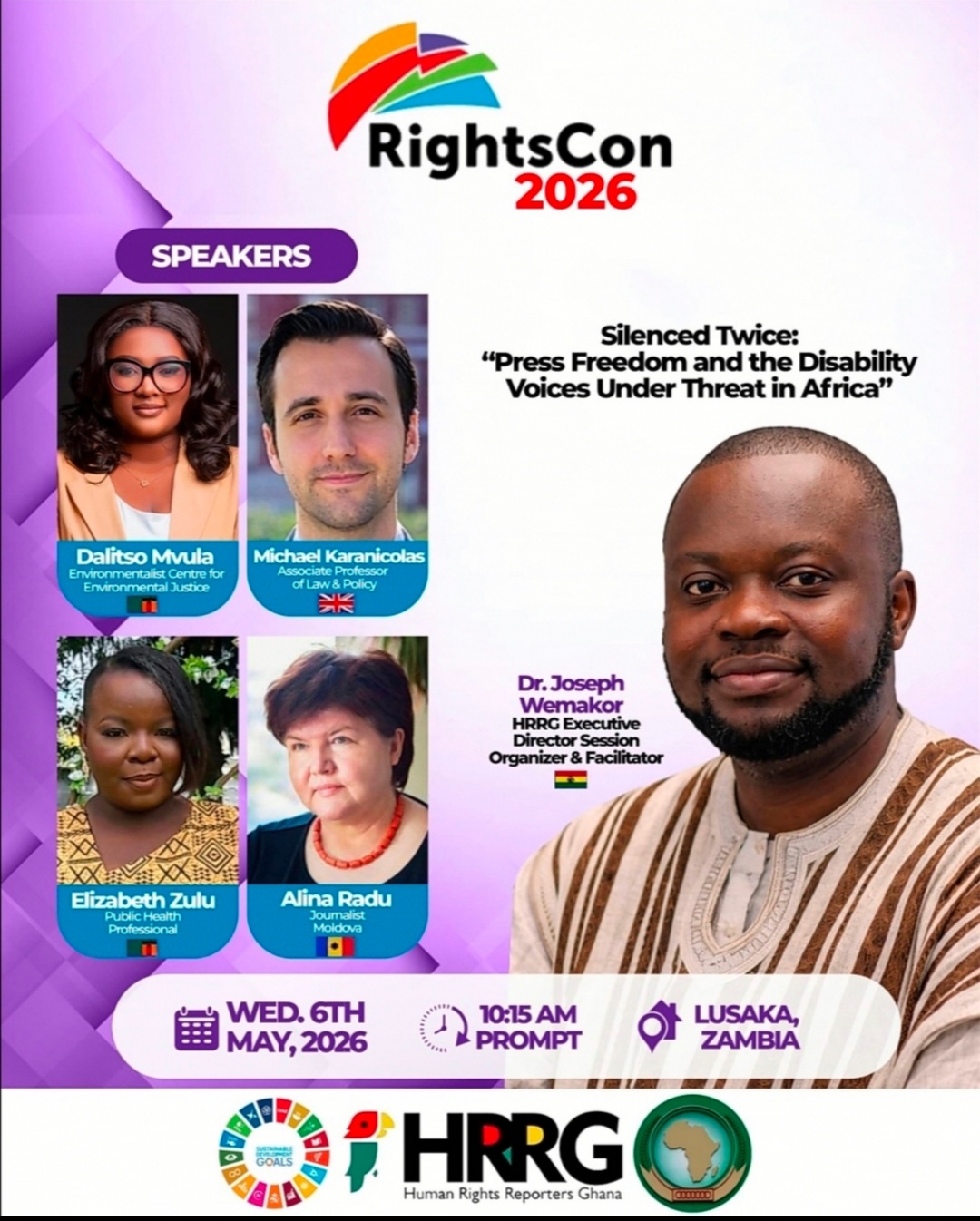
Human Rights Reporters Ghana (HRRG) is set to take its advocacy for inclusive media systems and civic participation to the global stage at RightsCon 2026 in Lusaka, Zambia.
The organization will host a high-level dialogue session on Wednesday, May 6, 2026, at the Mulungushi International Conference Centre (Kenneth Kaunda Wing), from 10:15 to 11:15 a.m.
The session, titled “Silenced Twice: Press Freedom and Disability Voices Under Threat in Africa,” will examine the growing challenges of shrinking civic space, restrictions on media freedom, and the persistent marginalization of persons with disabilities across Africa.
It forms part of the global RightsCon Summit convened by Access Now, a leading international organization based in New York dedicated to defending and expanding digital rights worldwide.
At the centre of the dialogue is the urgent question of inclusion—who gets to speak, who is heard, and who is left out of public discourse in increasingly constrained civic environments.
According to HRRG, persons with disabilities often experience what advocates describe as “double marginalization”—a situation where structural exclusion in society is compounded by limited representation in media systems that shape public opinion and policy.
Speaking ahead of the session, Executive Director of HRRG, Dr. Joseph Kobla Wemakor, said the conversation is both timely and necessary.
“Press freedom and disability inclusion are deeply interconnected. When the media space shrinks, the voices of already marginalized groups are often the first to disappear,” he noted.
The session will explore practical strategies to strengthen inclusive media ecosystems, safeguard freedom of expression, and expand equitable access to digital and civic spaces across Africa and beyond.
It will also highlight the responsibility of journalists, policymakers, civil society organizations, and international institutions in protecting fundamental freedoms and amplifying underrepresented voices.
A diverse panel of international experts will lead the discussion.
These include Dalitso Mvula of the Centre for Environment Justice in Lusaka, focusing on climate governance and inclusive environmental advocacy; Michael Karanicolas, an Associate Professor of Law and Public Policy and a global authority on freedom of expression and digital governance; and Alina Radu, an award-winning investigative journalist and co-founder of Ziarul de Gardă in Moldova, known for her anti-corruption and media independence work.
Others are Elizabeth Zulu, a public health expert working on health equity and community engagement, and Joseph Mwanza, a disability rights advocate and Programs Officer at Disability Rights Watch, who will contribute practical perspectives on disability inclusion and grassroots advocacy.
Across Africa, concerns over press freedom continue to deepen, with journalists facing increasing threats including harassment, intimidation, arrests, and digital surveillance. In Ghana, the killing of investigative journalist Ahmed Hussein-Suale in 2019 remains a painful reminder of the risks faced by media practitioners.
At the same time, persons with disabilities continue to encounter barriers such as inaccessible digital platforms, limited representation, and weak policy inclusion—factors that further limit their participation in democratic processes.
HRRG believes the Lusaka dialogue will contribute meaningfully to global efforts aimed at protecting press freedom, strengthening inclusion, and building more resilient democratic systems in the digital age.
The organization also expects the session to produce actionable recommendations, including stronger legal protections for journalists, improved accessibility of media platforms, and more inclusive digital governance frameworks.
Human Rights Reporters Ghana (HRRG) is a frontline civil society organization committed to advancing human dignity, social justice, democratic accountability, and inclusive development in Ghana, across Africa, and globally.
For over a decade, HRRG has worked with women, children, youth, rural communities, and other marginalized groups to promote rights awareness, civic participation, and accountability in governance.
Its work spans child protection, women’s rights and gender justice, environmental and climate justice, civic space protection, policy advocacy, access to justice, investigative journalism, research and documentation, as well as capacity building for civil society actors, journalists, and community leaders.
HRRG has received several international recognitions, including the 5th UN Global Entreps Award for Best International Practice on Sustainability under its KTT Project, which has impacted over 60,000 beneficiaries.
It has also been honoured with the Africa Peace Advocate Award (2023), recognition at the African Human Rights Defenders Shield Awards (2023), and ranked among the Africans Rising Activism Award – Movement of the Year (2020).
Other recognitions include the Honorary Award for Peace, Security and Education at the Africa Early Childhood Education Awards (2021), listing among Ghana’s 100 Most Impactful Changemakers (2024), and recognition by the World Bank for contributions to global research on equality and inclusion.
Beyond Ghana, HRRG convenes and supports more than 500 civil society organizations through the Ghana Civil Society Organizations Platform on the SDGs and has represented the country at major international forums, including the United Nations High-Level Political Forum and the Pan-African Human Rights and Social Justice Conference.
About The Author
